A Case For English As A Global Lingua Franca
Abstract:
We were tasked with writing an essay that uses research to make an argument about language. Along with the essay, we also had to create a “translation” that turned our written argument into a visual project.
Translation 2: Poster
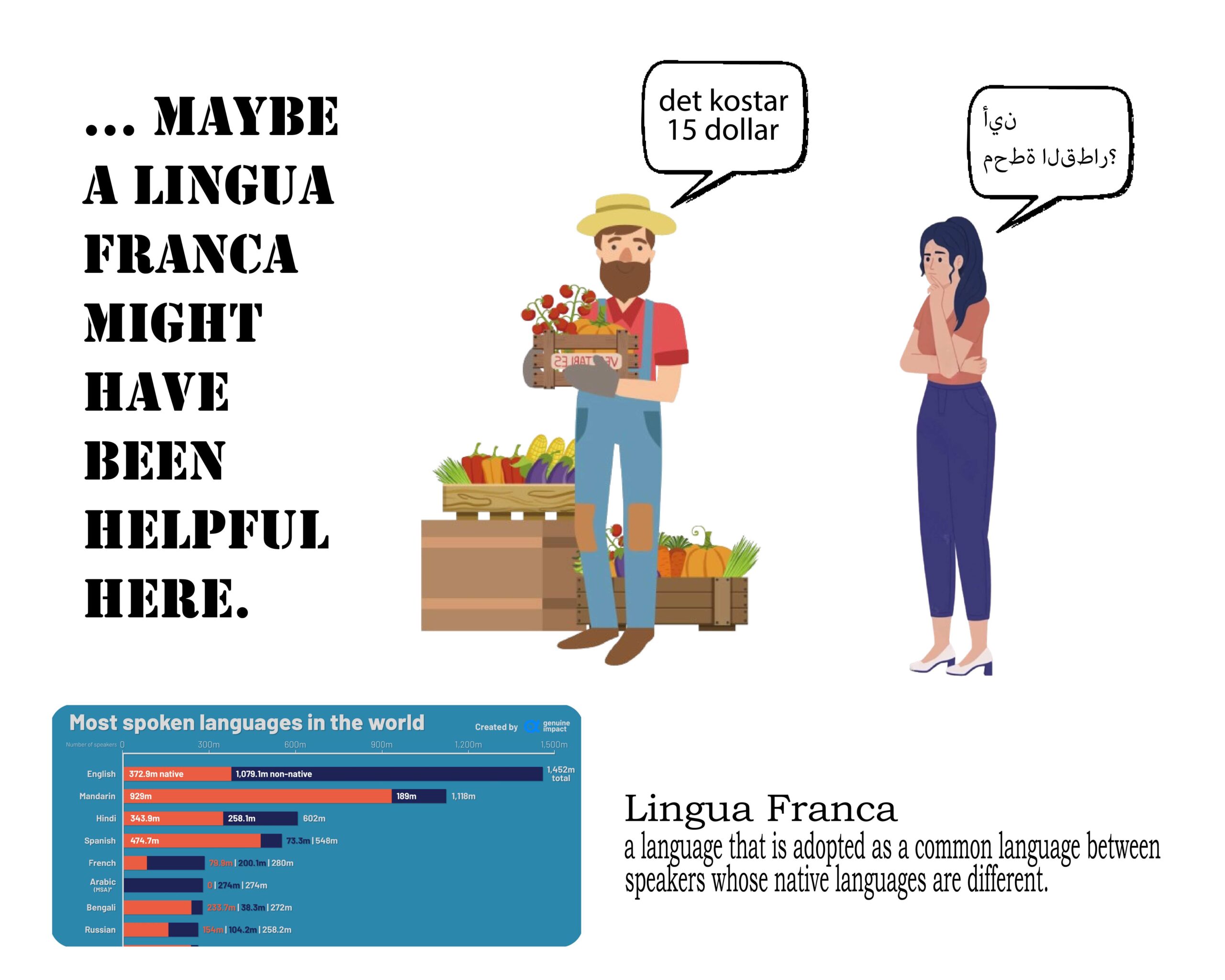
First draft:
A lingua franca is a language in which people with different native languages communicate through as a common language. It is typically used in areas where multiple language groups interact and trade ideas and goods. And it is because of a lingua franca that people from different languages are able to talk to each other without having a translator around. Much of today’s lingua francas have come to be due to colonialism. The national language of Singapore for example includes English, Malay, Mandarin and Tamil but in parliament, politicians mostly use English when conducting business and debates even though most of the people in Singapore do not have English ancestry. Not all lingua francas are a result of colonialism. In Africa for example, many people choose to speak languages like Swahili in East Africa and Arabic in much of north and west Africa. The use of lingua Francas does lead to a loss of Native Languages as there would be less of an emphasis on learning native languages to just focus on the language that would get you jobs and would allow you to talk to most people. However Lingua Francas are ultimately good for the world as it bridges many peoples together.
In this letter to the guardian, “Not sorry for helping make English Africa’s lingua franca”, Maurice Georg, a former lecturer of English in colleges in central Africa, writes that he is not at all regretful for teaching thousands of african students english in this 17 year tenure as he believes it’s important for these young africans to be able to speak english to shape the future of their continents and that it is important to have one common language that is also a global language. He conveyed this idea by sharing his experiences in the classroom and by sharing his perspective as an African who has learned this Lingua Franca. In his letter he talks about his students who he says know very well that by learning this foreign lingua franca, they wouldn’t have to learn the “70 local languages” or learn one while also “igniting the anger of speakers of the other 69 tribal tongues”(“Not sorry for helping make English Africa’s lingua franca”, para 2). Many of the students that Georg has taught over the years have most likely come from different and at times conflicting languages but now these students have the chance to learn together under one language. This of course causes a bridge to appear between the students and if enough of these bridges could be built then you will have the foundation to build a connection between tribes that were once conflicting. This point is echoed in the article written by Gillian Mansfield, a researcher and professor of The university of Parma in Italy titled “The English as a Foreign Language / Lingua Franca Debate: Sensitising Teachers of English as a Foreign Language Towards Teaching English as a Lingua Franca” where she goes into depth on shifting from teaching english as a foreign language to teaching english as a lingua franca. She argues that due to globalization, English has become a sort of lingua franca around the world and in order for better communication teachers should teach the whole variety of English spoken throughout the world. In her article she also talks about her views as a teacher and talks about how she , like Georg, knows the importance of teaching English at universities as a means to prepare students for a more globalized world (Gillian Mansfield,13). Europe as a continent had the most amount of wars in recorded history and it was until recently where many European countries began to sit down and converse with each other that we see the most peaceful times it has. Their open border policy might as well be the biggest factor of it. But even with that, what’s the point of having a possibility of getting close with people if you can’t communicate with each other. You would only set yourself up for more trouble as people would be more open to division. However, by teaching their students a global language like English, Mansfield is giving a means of communication to her students in which they would make friends, allies and partners with people from across the borders and from all over the Continent and little by little ultimately connecting everyone together. If Africa is to achieve a similar result of peaceful times then Georg is 100% correct in not feeling regretful for teaching his students English. He is just showing his students and giving them the ability to bring a more peaceful time. I believe that many of the conflicts in Africa arise from the lack of communications. If people were to communicate more often they would first see the many similarities each of them share and notice how their struggles are very similar to one another. This is how many countries in Europe were able to form relative peaceful positions with each other. If you look at the countries that speak mainly English which are The US, UK, Australia, New Zealand and Canada, you will notice that this group of countries for some reasons have very close relations. This can be at the very least attributed to the similarity in their common tongue.
In a study conducted by Hyejin Ku, a researcher at the university college London, where she looked at if English as a lingua franca can eliminate Trade barriers. Specifically, she tested whether there was a positive correlation between mean TOEFL Scores of Non-English speaking countries and the Trade volume between geographically close countries using the Gravity Equation. With this method Ku determined that “ improvements in English proficiency, while typically not very large, can nevertheless significantly raise trade” (Hyejin Ku, 6). Trade is competent of GDP and the more you export the greater a country’s GDP will be. So imagine a country’s GDP just increasing because people on average learned more English to be able to communicate and trade with their neighboring nations. An increase in countries GDP with constant Population would mean an increase in GDP per Capita, a measure of economic prosperity within a country. Exports aren’t the only thing that will help a growing country, imports have the benefit of allowing consumers within a country to buy goods at a lower price compared to their domestic prices. And in today’s world much of the goods can be found Online and most of these websites selling goods are in English. By people learning English as a foreign language, people around the world now have access to goods that might have been previously unavailable. The benefit of trade can be further expanded when you look at how prevalent English is on the internet. Ani Petrosyan, a cybersecurity analyst and researcher who also specialized in social anthropology, conducted a survey to determine the most used Language on the internet. She found that “English was the dominant language for online content” with nearly a majority at around 49.2% of the Websites around the world are in English with “Spanish ranked second, accounting for around 6 percent of web content.” ( Petrosyan, Para 1). The amount of information that is available on the internet is very vast. If people from a remote village were to be able to access just 50% of the things found on the internet, they would certainly be able to make a considerable impact on the lives of everyone in their community through innovation and communication from other parts of the world. This use doesn’t have to be a means of only importing knowledge but can be exporting the knowledge as well. Through the use of English people would be able to share their ways of life and maybe innovations and techniques they have acquired to a much larger community. Not only will learning English allow people to reach a broader audience but it will allow for information to not be lost in translation as people who accumulated the knowledge that they are sharing will be the best people to explain to others its use and benefits, not the translators. Trade does not only mean the transfer of goods between countries , it can also mean the exchange of ideas from one place to another. Using English as a Lingua franca will allow academics to converse with one another in a manner that facilitates connection rather than a feeling of isolation. It can allow sharing software developers to work together from around the world to help all of the world. By using English as a common language between neighboring nations you also allow independent arts and freelancers to find posting from a different place. This not only allows for a diffusion of culture but also allows for people whose talents aren’t valued in one place to broaden their market to find people who will pay them for their work.
Final Draft:
A lingua franca is a language in which people with different native tongues communicate through, as a common language. It is typically used in areas where multiple language groups interact and trade ideas and goods. And it is because of a lingua franca that people from different languages are able to talk to each other without having a translator around. Nigeria, which has around 500 different native languages, was under British rule from 1914 to 1960 and as a consequence of this, her current national language is English. This is not a one off situation. Due to Imperial British rule, many countries around the world have adopted English as their national language. Though English is not the world’s most spoken native language it does have the most total speakers at around 1.5 billion people. We should adopt English as a global lingua franca so that we can build work towards global peace and increase economic opportunities.
In the study “Lingua franca: The role of English in international trade” conducted at the University College London and The Hebrew University of Jerusalem, researchers looked at if English as a lingua franca can eliminate trade barriers. Specifically, the researchers tested whether there was a positive correlation between changes in mean TOEFL scores of Non-English speaking countries over 30 years and the Trade volume between geographically close countries. With this method, the researchers determined that “ improvements in English proficiency, while typically not very large, can nevertheless significantly raise trade” (6). Trade is a component of GDP and the more you export, the greater a country’s GDP will be. So, we can now come to the conclusion that a country’s GDP will increase when people on average learn more English to be able to communicate and trade with their neighboring nations. An increase in a country’s GDP with a constant population size would mean an increase in GDP per Capita, a measure of economic prosperity within a country. So learning English also has the added benefit of improving the average economic wellbeing of people within a country. Exports aren’t the only thing that will help a growing country. Imports allow consumers within a country to buy goods at a lower price compared to their domestic prices. By people learning English as a lingua franca, people around the world now have access to goods that might have been previously unavailable or on low stock.
The benefit of trade can be further expanded when you look at how prevalent English is on the internet. Christy Tila, a researcher who also specializes in societal and economic trends, conducted a survey, “Languages most frequently used for web content as of October 2025, by share of websites” to determine the most used language on the internet. Tila found that “English was the dominant language for online content” with nearly a majority at around 49.2% of the Websites around the world are in English with “Spanish ranked second, accounting for around 6 percent of web content.” The amount of information that is available on the internet is very vast. If people from a remote village were to be able to access just 50% of the things found on the internet, they would certainly be able to make a considerable impact on the lives of everyone in their community through innovation and communication from other parts of the world. This use doesn’t have to be a means of only importing knowledge but can be exporting the knowledge as well. Through the use of English, people would be able to share their ways of life and maybe innovations and techniques they have acquired to a much larger community. Not only will learning English allow people to reach a broader audience but it will allow for information to not be lost in translation. People who accumulated the knowledge that they are sharing will be the best people to explain to others its use and benefits, not the translators.
Trade does not only mean the transfer of goods between countries, it can also mean the exchange of ideas from one place to another. Rich people and big corporations already use this idea to their advantage by hiring translators. However, hiring these translators or using an accurate online translator software is not available to everyone, especially to those who live in developing nations. Using English as a Lingua franca allows academics to converse with one another in a manner that facilitates connection rather than a feeling of isolation. It can allow software developers to work together from around the world to help all of the world. It allows small independent artists and freelancers to find postings from different places. Ultimately, it is a tool for diffusing culture and techniques globally by allowing people who can’t find opportunities domestically to broaden their market and find people who will pay them for their work.
Not only can a lingua franca broaden one’s financial opportunities, but allow people to connect on a personal level. In this letter to the Guardian, “Not sorry for helping make English Africa’s lingua franca,” Maurice Georg, a former lecturer of English in colleges in central Africa, writes that he is not at all regretful for teaching thousands of African students English in his 17 year tenure. He believes it’s important for these young Africans to be able to speak English to shape the future of their continents and that it is important to have one common language that is also a global language. He conveyed this idea by sharing his experiences in the classroom and by sharing his perspective as an African who has learned this Lingua Franca. In his letter he talks about his students who he says know very well that by learning this foreign lingua franca, they wouldn’t have to learn the “70 local languages” or learn one while also “igniting the anger of speakers of the other 69 tribal tongues” (para. 2). Many of the students that Georg has taught over the years have most likely come from different and at times conflicting languages but now these students have the chance to learn together under one language. This of course causes a bridge to appear between the students and if enough of these bridges could be built then you will have the foundation to build a connection between tribes that were once conflicting.
This point is echoed in the article written by Gillian Mansfield, a researcher and professor of The University of Parma in Italy titled “The English as a Foreign Language / Lingua Franca Debate: Sensitising Teachers of English as a Foreign Language Towards Teaching English as a Lingua Franca” where she goes into depth on shifting from teaching English as a foreign language to teaching english as a lingua franca. Mansfield argues that due to globalization, English has become a sort of lingua franca around the planet and in order to communicate more effectively, teachers should teach the whole variety of English spoken throughout the world. In her article, she also talks about her views as a teacher; like Georg, she knows the importance of teaching English at universities as a means to prepare students for a more globalized world (13). Many neighboring countries in Europe have been at war for much of their history and it was until recently where many European countries began to sit down and converse with each other that we see the most peaceful times it has. Their open border policy garnered from talks at the European Union might be the biggest factor of it. This policy certainly did allow for Europeans to travel throughout the continent. But even with that, what’s the point of having a possibility of getting close with people if you can’t communicate with each other. You would only set yourself up for more trouble as people would be more open to division. However, by teaching their students a global language like English, Mansfield is giving a means of communication to her students in which they would make friends, allies and partners with people from across the borders and from all over the continent and little by little ultimately connecting everyone together.
If Africa is to achieve a similar result of peaceful times, then Georg is 100% correct in not feeling regretful for teaching his students English. He is just showing his students and giving them the ability to bring more harmony within the community.
Much of the world today is in disarray and many around the world suffer from economic instability. However, using English as a common language in a world with over 7000 languages can ultimately allow for a more peaceful time and be able to uplift many of the countries from economic downturn and increase brain power within a nation. Yes, many might still say that many of the world’s native languages might get lost but think about it in a positive vs negative way. Whenever you are prescribed medication, there are always negative effects but doctors still encourage us to take those medications because the good that can come out of this is overwhelmingly much better and helpful than the bad. Maybe the use of a lingua franca might even allow for academics around the world to preserve the language for the rest of history. For now though we should just focus on improving our own English a little at a time and by doing so we set ourselves to think globally for all of mankind.
Work Cited:
Ku, H., & Zussman, A. (2010). Lingua franca: The role of English in international trade. Journal of Economic Behavior & Organization, 75(2), 250–260. https://doi.org/10.1016/j.jebo.2010.03.013
Not sorry for helping make English Africa’s lingua franca | Letters. (2018). The Guardian (London).
Mansfield, G., & Poppi, F. (2012). The English as a Foreign Language / Lingua Franca Debate: Sensitising Teachers of English as a Foreign Language Towards Teaching English as a Lingua Franca. PROFILE Issues in Teachers’ Professional Development, 14(1), 159–172.
Tila, Christy. “Languages Most Frequently Used for Web Content as of October 2025, by Share of Websites.” Statista, 19 Nov. 2025, www.statista.com/statistics/262946/most-common-languages-on-the-internet/. Accessed 10 Dec. 2025.

